Main Menu

Showing posts with label News. Show all posts

Monday, 6 June 2016

Nice to meet Tsu: the new social network that Facebook doesn't want you to know about

Tsu.co, which pays users a portion of the advertising revenue made from their updates, claims that Facebook started deleting links to its site in September.


Facebook is deleting millions of links to its smaller rival Tsu.co, which pays users a percentage of the advertising revenue earned each time they update their status.
Tsu claims that in late September, Facebook started deleting more than 9.5 million links to its site. Facebook also blocks new posts that contain the text "tsu.co" but no links, warns users that links to Tsu are "unsafe" and fails to deliver Instagram posts and texts via Facebook Messenger that mention Tsu's Internet address or link to the site.
Facebook defends its Tsu ban as a way to prevent its service from turning into a hangout for scam artists and opportunists hoping to make a quick buck. Tsu says Facebook just doesn't want its users to realise that their photos, videos and personal observations might actually be worth something.

Facebook, which has an interest in protecting its 1.5 billion users from an onslaught of digital rubbish, is one of the internet's largest gatekeepers. That gives it extraordinary sway in determining who can reach its vast membership - not to mention what those members can discuss using its apps and services.
That can be a big issue when the subject involves a challenge to a company's core business - in this case, selling advertising against the material Facebook users contribute for free. Facebook has earned $2.1 billion on revenue of $12 billion during the first nine months of this year alone. The company now has a market value of about $300 billion, and no particular interest in generating traffic for a potential competitor.
There's a long history of similar disputes among technology companies, who almost always claim to be acting in the interests of their users. Amazon, for instance, recently yanked Google and Apple streaming-TV devices from its virtual shelves, clearing the way for its own. In just the past few days, several banks have blocked outside financial-planning apps from connecting to their systems, citing security concerns.
Tsu, which launched just over a year ago, has grown quickly; CEO Sebastian Sobczak says it has 4 million members. It has raised about $11 million in venture capital.

Tsu.co is winning converts to its social network by paying them for their posts. Facebook currently blocks all links from the smaller network, claiming theyíre low quality links that border on spam.

Facebook's Tsu purge came without warning and affected a swath of users that included rap artist 50 Cent, who shared a link to a video on Tsu with more than 38 million Facebook fans. The team that handles 50 Cent's social media accounts didn't respond to requests for comment.
Facebook says that Tsu pays its users to post links on other sites, an incentive that breaks its rules for connecting with its social network. In a statement, Facebook said it doesn't let outside publishers pay users to post links on its network "because it encourages spammy sharing."
Mr Sobczak denies that his service is paying people to post links on Facebook. Tsu users are paid based on how much advertising it sells alongside their posts. That revenue-sharing setup is similar to financial models used by major digital services such as Google's YouTube; Facebook users widely share YouTube links with one another.
"It feels like we are being singled out and they are trying to stop a competitor with a more efficient business model," Mr Sobczak says. "What are they afraid of?" Mr Sobczak, a former venture capitalist, says Facebook hasn't responded to his inquiries.
Claudia Everest, a frustrated Facebook user who embraced Tsu to find buyers for her $30 drawings of dogs, says Facebook is trying to deflect attention from Tsu's revenue-sharing concept.
"I don't think they are afraid of Tsu as much as they are of anything that lets people know their content has value," says Everest, who lives in Stoke on Trent. "That picture you posted of your dinner last night may not seem like it has value, but it does to the advertisers."

For more Click

Source :- Telegraph

Monday, 23 May 2016

Calling All Kids! President Obama Wants Your Science and Tech Ideas

Inspired by the recommendation of a 9-year-old inventor during the White House Science Fair in April, President Barack Obama has put out a call to kids across the United States to share their thoughts on science, technology and innovation.

Both in and out of classrooms, kids know firsthand how to inspire students in the STEM fields — science, technology, engineering and math. So the president is asking young scientists and inventors to tell the White House what it can do to build the future of science, discovery and exploration

"Whether you care about tackling climate change, finding a cure to cancer, using technology to help make people's lives better or getting a human to Mars, we can't wait to get your input!" John Holdren, director of the Office of Science and Technology Policy, wrote in a White House blog post yesterday (May 19) to announce the initiative.
The online form (which doesn't require kids to submit personal information) includes questions such as, "What is your favorite thing about science, technology, engineering or math?" and "If you could pitch the president one idea on how we could make our country work better using science and technology, what would you say?"

Holdren also noted the president's long record of encouraging kids to engage with science and technology.

"He recognizes that the future of our country depends on the innovations and advances of today's students," Holdren wrote.

"One of the things I find so inspiring about these young thinkers is that they look at all these seemingly intractable problems as something that we can solve," Obama said at the time. "There is a confidence when you are pursuing science. They don't consider age a barrier. They don't think, 'Well, that's just the way things are.' They're not afraid to try things and ask tough questions."

From the inventions they've tried to the questions they've asked, students interested in STEM are encouraged to submit their ideas through the White House's blog.

For more click


Source :- Live Science

Tuesday, 10 May 2016

The Weird History of Gender-Segregated Bathrooms


In North Carolina and other states, a new culture war has erupted. This time, the battlefield is bathrooms.

In March, North Carolina enacted a law (colloquially known as HB2) that requires that people use only bathrooms that correspond to the gender on their birth certificates. The law affects transgender individuals, who identify as a gender other than the one they were assigned at birth. Other states have considered similar bills, to great controversy.

To some people, public bathrooms may seem like unassuming spaces — necessary but not worth too much thought. But these bathroom bills illustrate that public restrooms are the stage for many complex social interactions, and that the availability of a place to relieve oneself is crucial in society.


Public or private?


Gender-segregated public restrooms are either very old or very new, depending on how you look at the question. They arose in the Victorian era, along with widespread plumbing, meaning they've been around almost as long as the modern bathroom itself. On the other hand, having privacy for peeing is a relatively modern phenomenon.  

The notion of privacy itself is shifting constantly, and it can be hard to determine how people of the past viewed the importance of privacy in their bathroom habits. Ancient Rome, for example, is famous for its multiseater bathrooms, where people sat side by side on benches, without partitions, to do their business. However, there are hints that a concept of privacy might have existed. In Hadrian's Villa, a second-century site in Tivoli, Italy, there were multiseat facilities for servants and staff, according to a 2003 paper in the Journal of Roman Archaeology. However, the emperor and high-status guests seem to have had access to relatively private single-seaters. [Through the Years: A Gallery of the World's Toilets]

"[T]he provision of single-seaters, especially for guests, shows that, when space and money were no object, [the elite] preferred single toilets," wrote study researcher and independent archaeologist Gemma Jansen.

The first gender-segregated public restroom on record was a temporary setup at a Parisian ball in 1739, said Sheila Cavanagh, a sociologist at York University in Canada and author of "Queering Bathrooms: Gender, Sexuality, and the Hygienic Imagination" (University of Toronto Press, 2010). The ball's organizers put a chamber box (essentially a chamber pot in a box with a seat) for men in one room and for women in another.

"Everyone at the ball thought this was sort of a novelty — something sort of eccentric and fun," Cavanagh said.

But for the most part, public facilities in Western nations were male-only until the Victorian era, which meant women had to improvise. If they had to be out and about longer than they could hold their bladders, women in the Victorian era would urinate over a gutter (long Victorian skirts allowed for some privacy). Some would even carry a small personal device called a urinette that they could use discretely under their skirts and then pour out, Cavanagh said. Strangely, these urinettes were sometimes shaped like the male genitals. [How Much Urine Can a Healthy Bladder Hold?]

This lack of female facilities reflected a notable attitude about women: that they should stay home. This "urinary leash" remains a problem in some developing nations, said Harvey Molotch, a sociologist at New York University and co-editor of "Toilet: The Public Restroom and the Politics of Sharing" (New York University Press, 2010). Women in India today, for example, often have to avoid eating or drinking too much if they have to be out in public, because there is no place for them to go, Molotch told Live Science.


Ladies and gentlemen


Thus, the first gender-segregated restrooms were a major step forward for women. Massachusetts passed a law in 1887 requiring workplaces that employed women to have restrooms for them, according to an article in the Rutgers University Law Review. By the 1920s, such laws were the norm.

Victorian-era Americans were segregated by gender in many spaces, Molotch said. There were ladies-only waiting rooms in train stations, and female-only reading rooms in libraries. As sex segregation has fallen to the wayside in other public spaces, bathrooms remain the last holdout, he said.

"Restrooms are a very funny place, because they're where the most intimate actions occur that are also in public," Molotch said. In the U.S., bathrooms are partitioned with flimsy barriers with lots of gaps, in part because of anxiety over what might go on in a fully private stall. Sex and drugs are the most common of these concerns, he said.

Meanwhile, people observe rigid social rituals to keep up the illusion of privacy. Men, for example, can't be seen looking at the genitals of other men, Molotch said, but also can't be perceived as trying not to look. [10 Things That Make Humans Special]

"The disgust attached to excretion makes people bothered by the sounds and smells of others, and the shame of this private action makes many people concerned about being witnessed in the act, even indirectly," said Nicholas Haslam, a psychology professor at the University of Melbourne and author of "Psychology in the Bathroom" (Palgrave Macmillan, 2012). Excretion is seen as unfeminine, Haslam told Live Science, so women are under particular pressure to hide their bathroom activities, especially from men.

"Finally, the act of going to the bathroom makes many people feel vulnerable, exposed, and unsafe," Haslam said.

Bathroom bills like North Carolina's often reflect ideas about sex and safety, Cavanagh said. However, there are no documented instances of a transgender person attacking anyone in a public bathroom, she said. A survey published in the Journal of Public Management and Social Policy in 2013 did find, however, that 70 percent of the transgender respondents from the Washington, D.C., area had experienced harassment or assault in bathrooms, or had been denied access to facilities.

Ultimately, fears over allowing bathrooms to be used by people of different birth sexes may have more to do with the symbolic nature of public restrooms than with practical concerns. Transgender people challenge the notion that a person's gender and their biological sex at birth are one and the same in all cases, Molotch said, which makes some people uncomfortable. However, he suspects that the backlash will simmer down and that gender-segregated toilets will persist, with an agreement that everyone will mind their own business.

"We all know there is nothing more important to transgender people than to 'pass,'" Molotch said, meaning that transgender people want others who casually encounter them to assume they are just like all of the other members of the gender they identify with. Most transgender people do not want others to wonder whether they are transgender, he said.

For more click

Wednesday, 6 April 2016

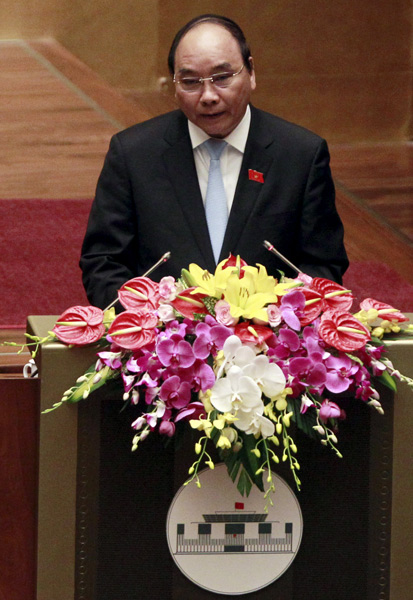
Nguyen Xuan Phuc elected Vietnam’s PM

Vietnam elected Thursday a new Prime Minister, Nguyen Xuan Phuc, to lead the emerging economy as it comes under increasing pressure to reform a scandal hit state-owned sector and banking system.

HANOI: Nguyen Xuan Phuc, 61, was elected Vietnam's Prime Minister on Thursday (Apr 7). He will lead the emerging economy as it comes under increasing pressure to reform a scandal hit state-owned sector and banking system.

Nguyen Xuan Phuc elected Vietnamese Prime Minister
Phuc, former Deputy Prime Minister, was sworn in after 446 of 490 legislators voted to approve his nomination.
Taking his oath, he swore loyalty to the country, its people and the Constitution of Vietnam.
"As the head of state’s highest organ, the executive organ of the National Assembly, the Government members and I will strive to build a strong and united Government,” the newly elected Prime Minister said in his acceptance speech.
Mr Phuc also vowed to enhance the effectiveness of anti-corruption and anti-waste, and firmly safeguard the sovereignty, territorial integrity and national unity.
The vote by Vietnam’s lawmaking National Assembly, however, was only a formality. The former Deputy Prime Minister was put forward for the top post at the Communist Party’s once-every-five-years National Congress earlier in January.
His election followed the formal stepping down of former premier Nguyen Tan Dung the day before.
"VERY CHALLENGING"
A native of Quang Nam province in central Vietnam, Phuc was elected to the Communist Party’s elite politburo in 2011, the same year he was appointed Deputy Prime Minister.
On Thursday, he took over from Dung, who stepped down on Wednesday after serving the maximum of two five-year terms as Prime Minister.  
Phuc is expected to face enormous challenges in restructuring the state-owned sector and banking system, improving the country’s fiscal position, and lifting Vietnam’s over-reliance on foreign investment.
Such changes require a measure of political reform and more than a stroke of luck, according to Dr Le Hong Hiep, a visiting fellow at the Institute of Southeast Asian Studies in Singapore.
Vietnam has set its growth target at 6.7 per cent for 2016, although prolonged drought threatening agricultural output could drag down growth for the year.
The government is also expected to meet the commitments of a slew of free trade deals Vietnam has signed or is negotiating, including the Trans-Pacific Partnership.
"It is undoubtedly a very hard job because the socio-economic situation in Vietnam is, nowadays, very challenging,” said a senior economist, Dr Le Dang Doanh.
“I think all people are expecting from him strong determination and strong step of reform."
'MORE CAREFUL'
Phuc's predecessor is no longer part of the Communist Party's top brass but still known for pushing Vietnam’s integration into the global economy and for taking a strong stand against China in the two countries’ territorial spat in the South China Sea.
His legacy has earned him praise at home but also criticisms from political opponents in the run-up to the January Party Congress, experts said.
Phuc is likely to follow Dung’s foreign policy rhetoric, but the new Prime Minister may be more careful if he wishes to speak up against China, according to Hiep.
The new Prime Minister becomes part of a new triumvirate with party chief Nguyen Phu Trong and President Tran Dai Quang, who was endorsed last week. Parliament will vote on a new cabinet on Saturday.

For more click

Panama Papers: Iceland PM Sigmundur Gunnlaugsson resigns


Prime Minister Sigmundur Gunnlaugsson leaves the residence of Iceland's President President Olafur Ragnar Grimsson after a meeting (5 April 2016)


Screengrab taken from video showing Iceland's Prime Minister Sigmundur Gunnlaugsson walking down stairs after a meeting in parliament (5 April 2016)

But Mr Grimsson said he first wanted to consult leaders of the Independence Party, which has been in the ruling coalition with Mr Gunnlaugsson's Progressive Party since 2013.

Gudlaugur Thor Thordarson, the chairman of the Independence Party, said the prime minister's request had come as a "total surprise" and was not "the rational thing to do".

Later, ahead of the proposed confidence vote, Mr Gunnlaugsson announced he was stepping down.

The Progressive Party's deputy leader, Agriculture Minister Sigurdur Ingi Johannsson, told reporters after a meeting that the party planned to name him as the new leader and propose that he become prime minister.

Despite the resignation, Katrín Jakobsdottir, head of the Left-Green Movement, told the Reuters news agency that opposition parties still wanted early elections.

Other Panama Papers reaction

  • Fifa president Gianni Infantino signed off on a TV rights contract with businessmen subsequently accused of bribery, leaked documents show
  • France returns Panama to a list of countries which fail to co-operate over tax evasion
  • Panama says it is considering retaliatory measures against France, but reiterates that is ready to co-operate with any investigations stemming from the leaks
  • Chile: the country head of the anti-corruption watchdog Transparency International, Gonzalo Delaveau, steps down after his name emerges in the documents
  • US President Barack Obama says tax avoidance is a global problem and governments should not make it easy for illegal funds to move around the world
  • Pakistan Prime Minister Nawaz Sharif orders judicial investigation into allegations of family links with offshore companies

  • The documents leaked from Mossack Fonseca show that Mr Gunnlaugsson and his wife bought the company Wintris in 2007.
    He did not declare an interest in the company when entering parliament in 2009. He sold his 50% of Wintris to his wife, Anna Sigurlaug Palsdottir, for $1 (£0.70) eight months later.
    Mr Gunnlaugsson maintains no rules were broken and his wife did not benefit financially.
    The offshore company was used to invest millions of dollars of inherited money, according to a document signed by Mrs Palsdottir in 2015.
    Court records show that Wintris had significant investments in the bonds of three major Icelandic banks that collapsed during the financial crisis which began in 2008.
    Some of Icelanders' anger is believed to stem from the perceived conflict of interest.
    The prime minister was involved in negotiations about the banks' future and had characterised foreign creditors who wanted their money back as "vultures", while Wintris itself was a creditor.
    Mr Gunnlaugsson had kept his wife's interest in the outcome a secret.
    In a resignation statement, Mr Gunnlaugsson said he had no wish to stand in the way of further government work, such as reform of the financial system.
    Addressing the issue of his wife's assets, the statement says the couple have "never sought to hide these assets from Icelandic tax authorities and these holdings in Wintris have been reported as an asset on the prime minister's wife's income tax returns since 2008 and taxes have been paid accordingly in Iceland.
    "No parliamentary rules on disclosure have been broken. Even the Guardian and other media covering the story have confirmed that they have not seen any evidence to suggest that the prime minister, his wife, or Wintris engaged in any actions involving tax avoidance, tax evasion, or any dishonest financial gain."

    Panama Papers - tax havens of the rich and powerful exposed

    • Eleven million documents held by the Panama-based law firm Mossack Fonseca have been passed to German newspaper Sueddeutsche Zeitung, which then shared them with the International Consortium of Investigative Journalists. BBC Panorama is among 107 media organisations - including UK newspaper the Guardian - in 76 countries which have been analysing the documents. The BBC does not know the identity of the source
    • They show how the company has helped clients launder money, dodge sanctions and evade tax
    • Mossack Fonseca says it has operated beyond reproach for 40 years and never been accused or charged with criminal wrong-doing"
For more click


Tuesday, 5 April 2016

North Korea threatens US of more deaths than 9/11 attack

North Korea threatens US of more deaths than 9/11 attack
 North Korea has claimed that if it could, it would kill more Americans than the 9/11 attacks.


According to an article in the country`s state-run publication DPRK Today, it said their weapons are trained on the White House, the Pentagon and other vital U.S. locations.
"If three civilian aeroplanes` attacks from 15 years ago resulted in 3000 deaths and brought a nightmare to life for the US, the outbreak of our final war will wipe the country from history, leaving no time [for them to] even regret or have nightmares about it," news.au.com quoted the reported article as saying.
The article added, "Being beaten by only three civilian aeroplanes, the US was ashamed in front of the world and has suffered incalculable psychological and economical damage."
The article comes soon after North Korea`s supreme leader Kim Jong-un defied a UN weapons ban to oversee the testing of Pyongyang`s new surface-to-air missiles.
North Korea continues missile launches during elevated military tension on the Korean peninsula. In recent weeks, North Korea has also claimed to have miniaturised a thermonuclear warhead that can fit on a ballistic missile which experts say the claims with a mix of fact and exaggeration.
The United States, Republic of Korea and Japan during the Nuclear Security Summit in Washington DC , had vowed to deter and defend against North Korean nuclear threats and stand united in fighting global terrorism.

For more click
Source :- Zee News